
how_to_playbook
949 Comments, 3 Retractions: Our AI Agent Marketing Workflow Runs on a Brand Profile, Not a Prompt
August 27, 2026 · 10 min read · Scout7
The AI agent marketing workflow behind 949 on-voice comments in 10 days: a canonical facts file, stance files and a banned-phrases list you can copy.
Introduction
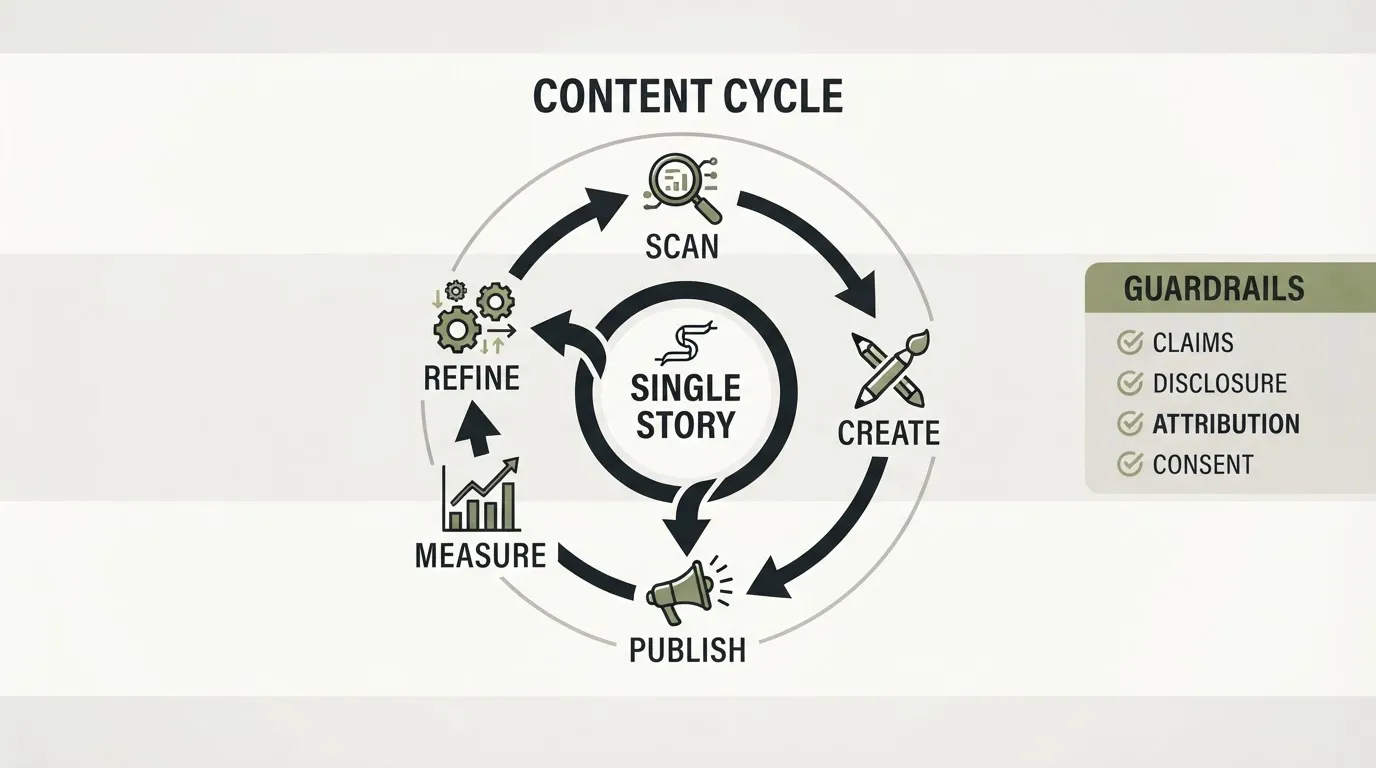
Your team already uses AI, but the work still feels manual: one prompt for a post, another for a reply, then a spreadsheet to track what happened. An AI agent marketing workflow fixes that by turning scattered tasks into one closed loop that scans, creates, publishes, and measures with written guardrails.
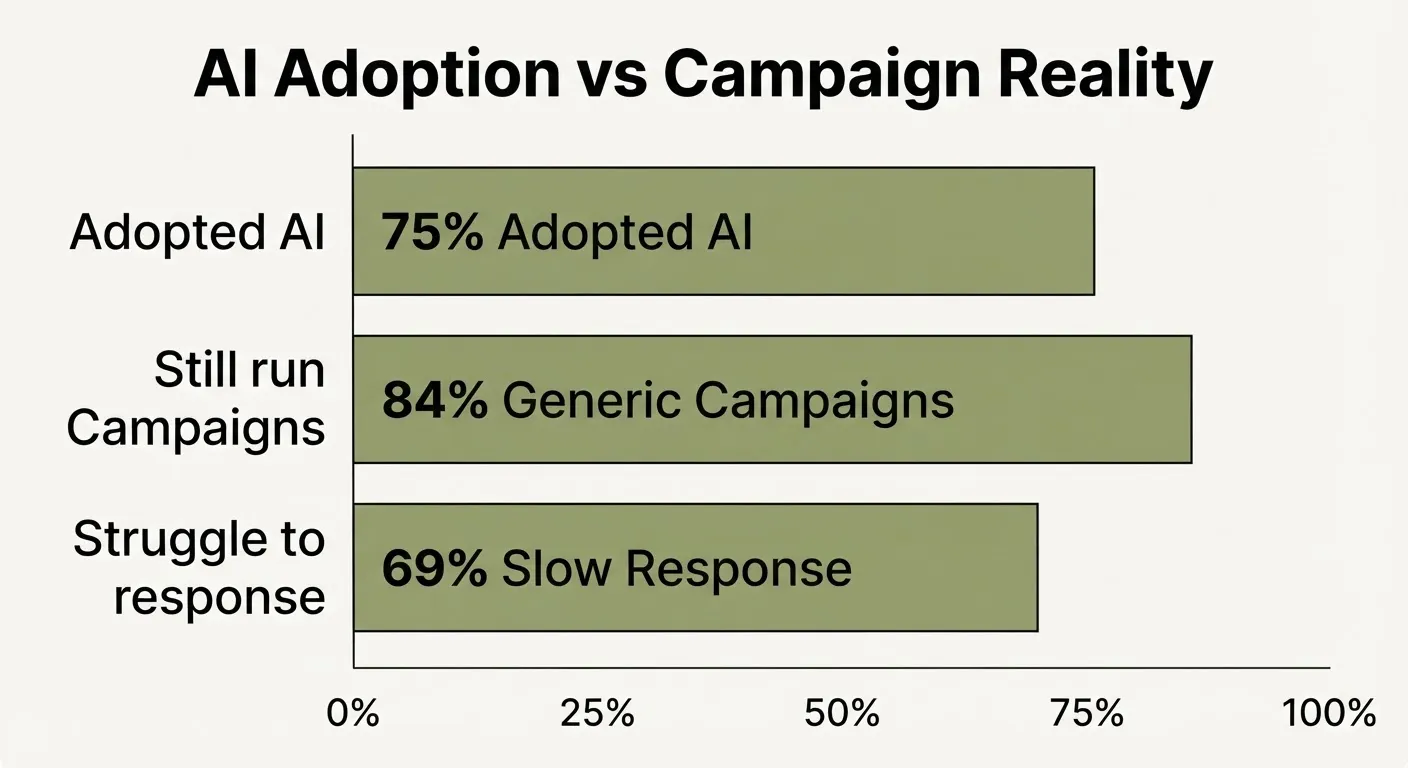
That gap is now the real issue. According to Salesforce’s State of Marketing 2026, about 75% of marketers have adopted AI, yet about 84% still run generic campaigns.
Key takeaways:
- Unify the story first with a canonical-facts file
- Build one loop: scan, create, publish, measure
- Use approval by exception instead of reviewing everything
- Improve artifacts, not prompts alone to avoid generic output
An Agentic Marketing system is not a pile of prompts. It is a governed workflow where an AI Agent can act across tools, reuse shared facts, and learn from outcomes.
That matters for B2B teams chasing organic growth, not just more output. Organic growth means earning demand through content, brand, search, and engagement rather than relying only on paid ads, and that is how small teams can reduce customer acquisition cost over time.
Step 1: Unify the Story Before You Unify the Data
If you wait for perfect data before you automate, the loop never starts. The faster move is to write one canonical version of the truth and let the workflow run inside it.
We started there, not with a perfect warehouse but with one canonical-facts file that defined who we are, what we can claim, and what we never say. That file took an afternoon, and it is what kept 949 automated comments on voice.
Based on what we saw when we codified one story and let agents operate inside written guardrails, small teams should manage exceptions instead of manually reviewing every output.
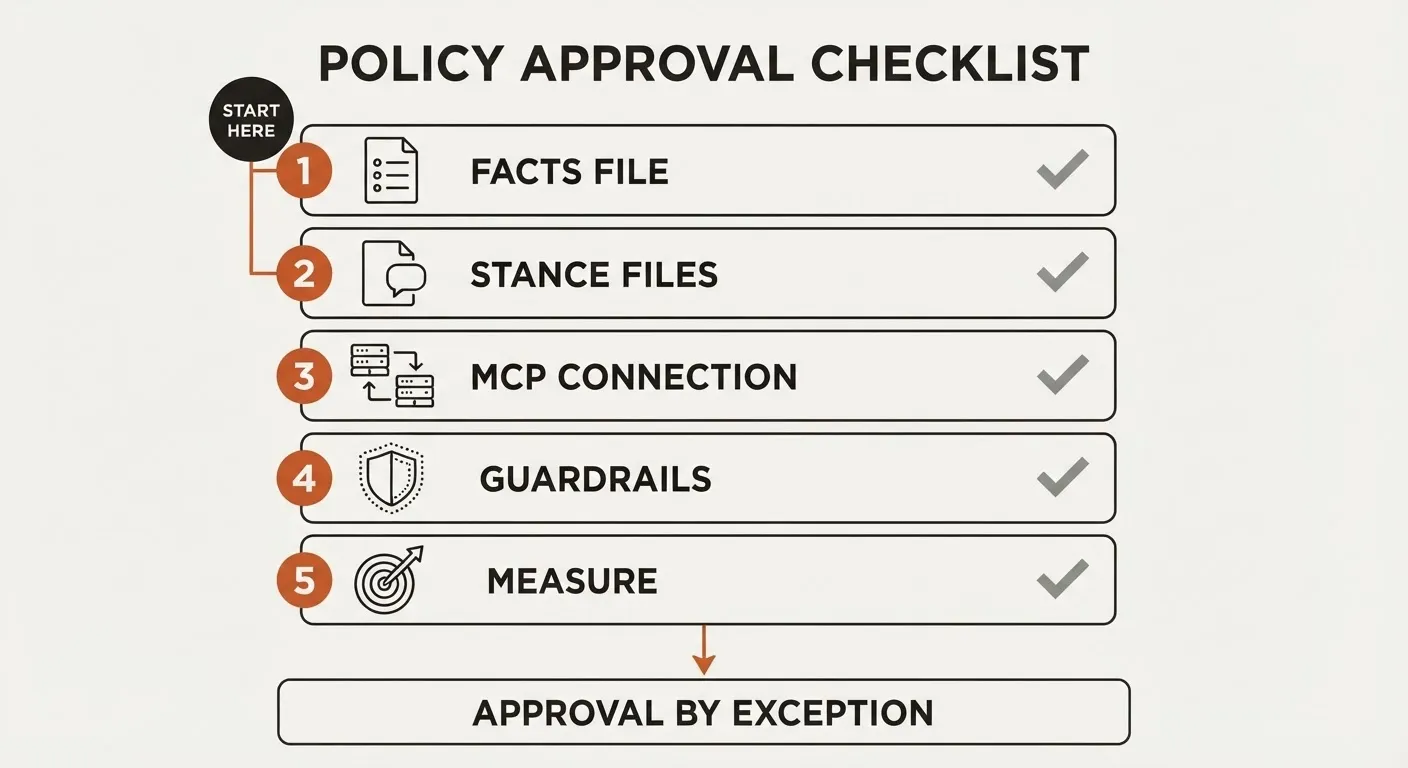
- Canonical-facts file first defines approved claims, banned claims, proof points, and disclosures
- Stance files second set channel tone, audience context, and platform boundaries
- Data can follow later without breaking the operating model
- Source of truth beats prompt memory when multiple assets publish at once
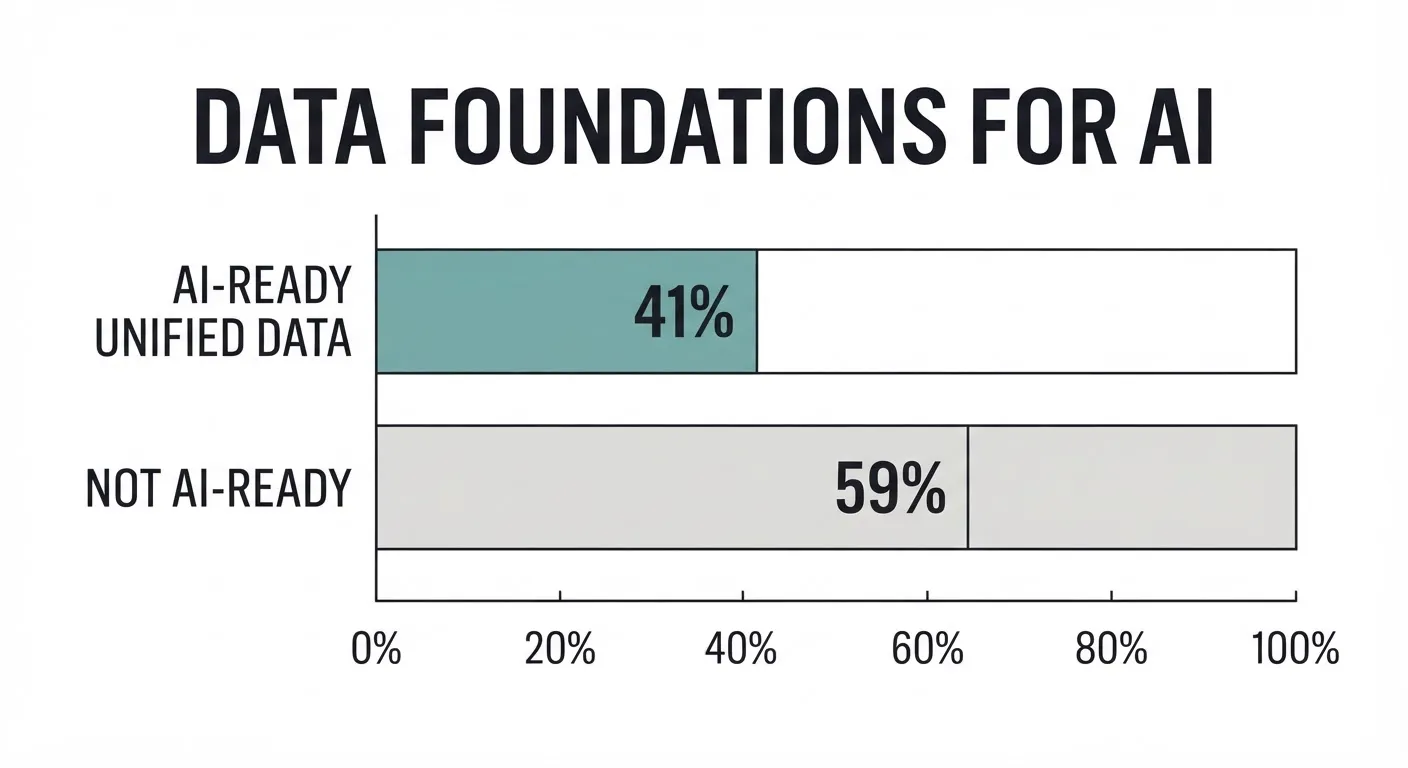
The long-term case for better data is real. Salesforce found teams with unified data are about 60% more likely to use AI agents to scale marketing, while Adobe’s B2B journey orchestration research found only about 41% of B2B organizations say they have an AI-ready unified data foundation.
So start smaller than enterprise readiness. Unify the story first, then wire that story into a real loop.
Step 2: Define the AI Agent Marketing Workflow — Scan to Measure
Once the story is written down, the next question is simple: what does the system actually do all day? If it stops at content generation, you do not have a Growth Loop; you have a faster bottleneck.
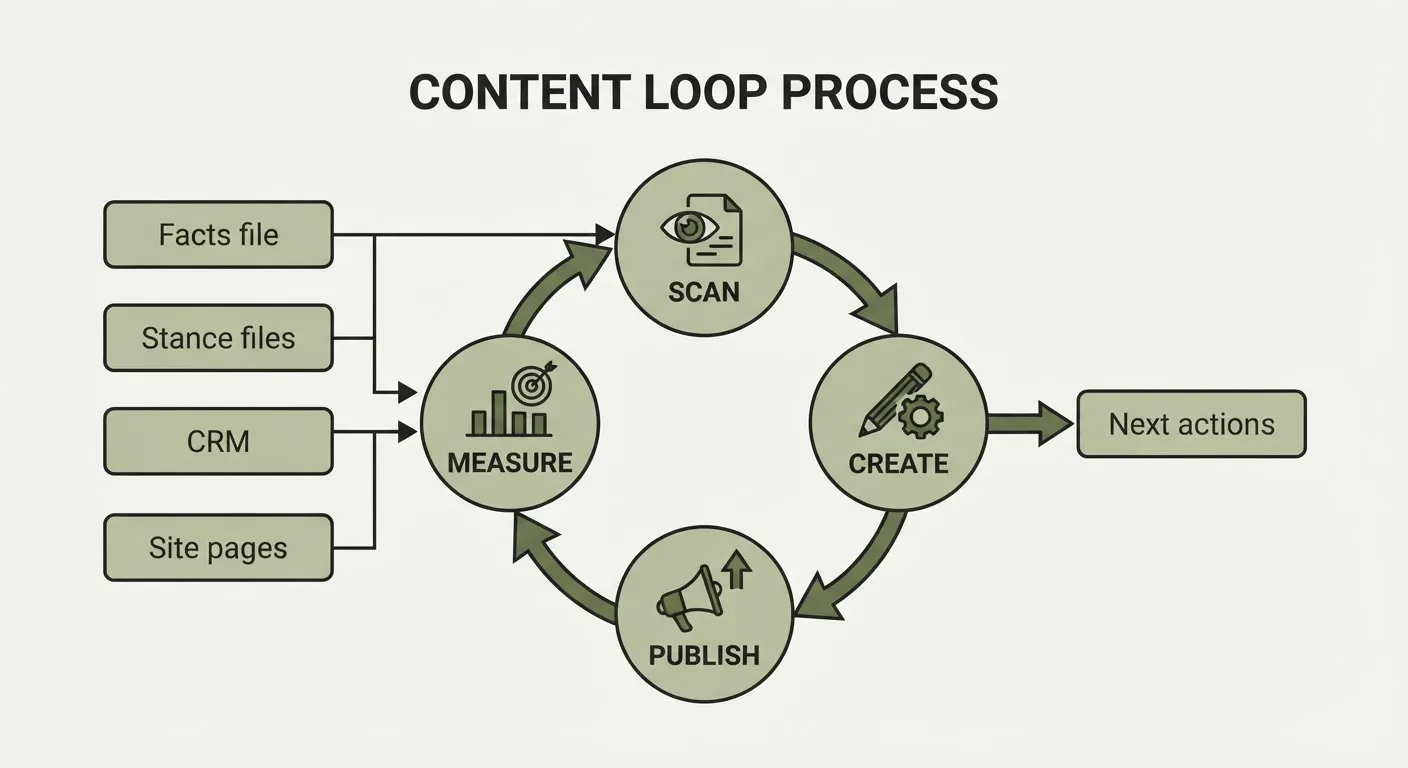
A workable agentic marketing workflow has four linked moves:
- Scan site pages, CRM notes, product updates, wins, and channel signals
- Create posts, articles, carousels, comments, and outreach from shared artifacts
- Publish to the right channel with disclosure, formatting, and attribution rules
- Measure engagement, replies, pipeline signals, and conversion outcomes
- Feed results back into the next scan so the system sharpens over time
This is where marketing automation matters. Marketing automation is the use of software to run repeatable marketing tasks with less manual work, but in this model the software does more than schedule emails; it closes the execution loop.
The market is moving this way fast. In Gartner’s 2026 CMO survey, AI-driven automation handles about 16% of marketing work today and leaders expect about 36% by 2028. McKinsey also found B2B buyers now use an average of 10 channels, and about 71% of B2B companies offer e-commerce, with roughly one-third of revenue coming through digital channels.
That channel sprawl is why the loop has to be designed as one system. The next step is connecting the agent to the stack that moves it.
Step 3: Connect the Agent Through MCP
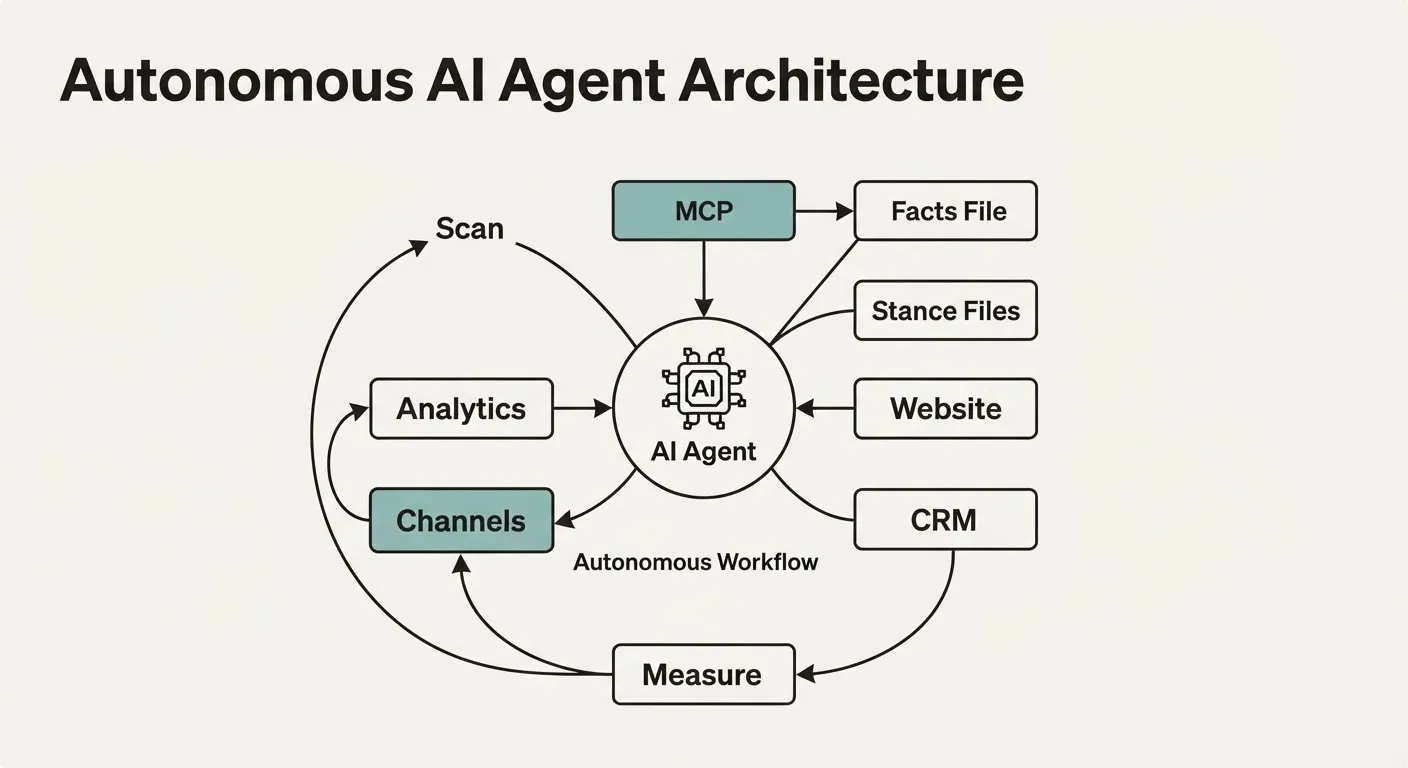
A real AI Agent should not live inside one chat window. It should sit on top of your workflow, read your source-of-truth artifacts, and trigger the next action across tools.
That is what makes an agentic workflow different from simple assistance. The agent reads context, reasons through the task, and executes against connected systems instead of waiting for a human to copy and paste.
- Keep truth outside the model in your canonical-facts and stance files
- Connect tools through MCP so the agent can act across systems
- Use one control layer for content, publishing, engagement, and measurement
- Swap models without rewriting strategy because the rules live outside prompts
For Scout7, that means one-line integration with tools teams already use, including [MCP](autonomous marketing growth loop), Claude, ChatGPT, Cursor, and similar systems. In practice, the best architecture keeps your facts, rules, and channel logic separate from the model so updates do not require prompt surgery.
That matters because scale is already uneven. McKinsey’s State of AI 2026 found about 40% of organizations with more than $1 billion in revenue are scaling AI agents, while smaller firms lag.
Small teams should not read that as a warning to wait. They should read it as a prompt to build lightweight operational foundations now.
Step 4: Write Guardrails, Not Endless Approval Queues
Once the agent can act, the temptation is to review everything. That feels safe, but it kills the loop.
We ran 949 automated comments in 10 days, and per-post human review would have made that impossible. We retracted 3 of 949, and one comment was deleted by a moderator because it read too obviously AI-written; that miss taught us to write the rules down instead of trusting prompts.
Scale comes from reviewing rules and exceptions, not manually touching every asset.
- Require disclosure such as “AI-generated” or “Powered by Scout7 AI”
- Enforce approved claims and block banned phrases before publishing
- Route exceptions only when claims, privacy, or platform policies conflict
- Respect consent rules with explicit opt-out and GDPR/CCPA handling
- Preserve attribution for third-party or endorsed content
This is approval by exception. Humans review the rule set, flagged outputs, and edge cases, not the whole production line.
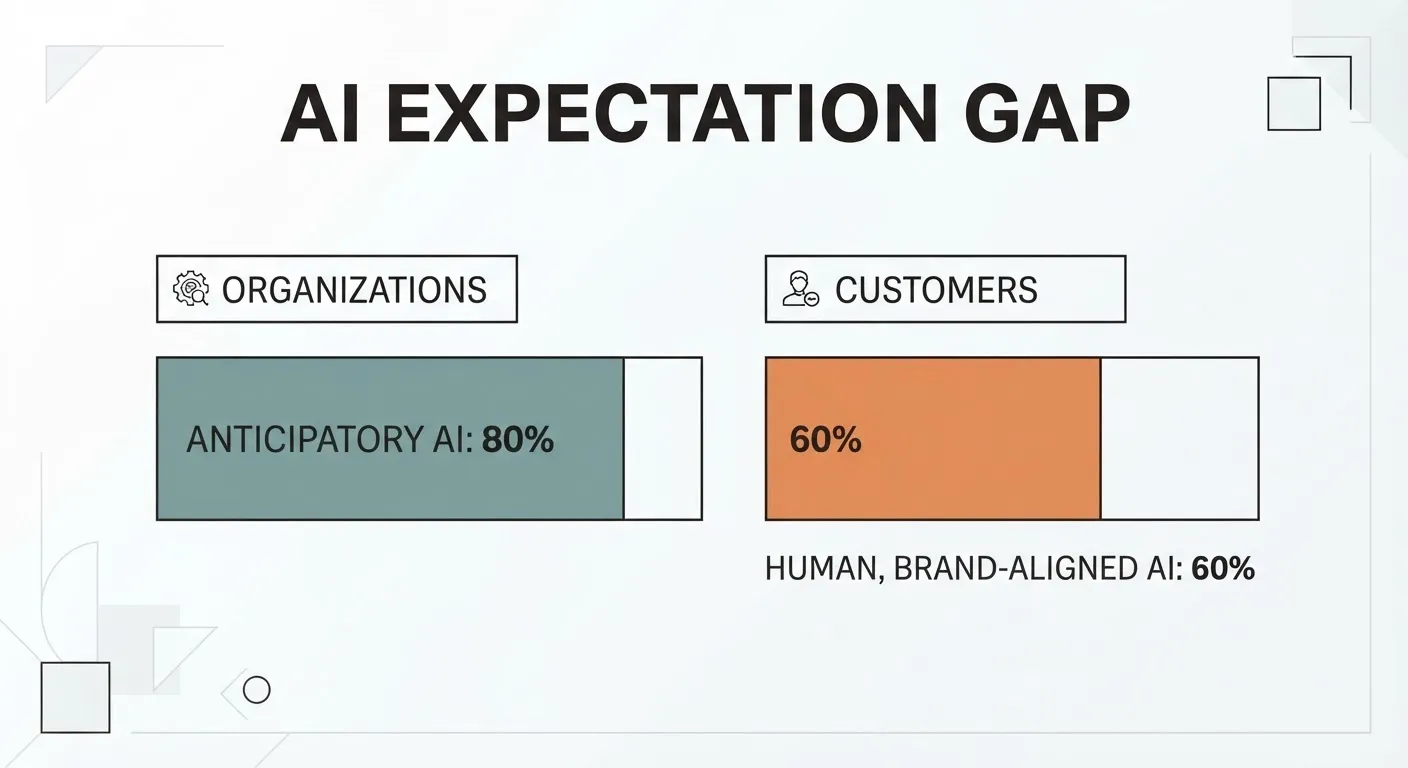
That governance gap matters. Adobe’s 2026 Digital Trends research found about 80% of organizations envision highly personalized AI-powered experiences, while only about 60% of customers say those experiences should still feel human and brand-aligned.
The system needs speed, but the brand still needs boundaries. The final move is making sure scale does not turn into blandness.
Step 5: Scale Without Becoming Generic
After guardrails are in place, the risk changes. The problem is no longer underproduction; it is producing safe, forgettable work at high volume.
That is where measurement becomes a moat. You are not trying to make more assets. You are trying to make the loop learn.
- Track signal quality across formats, offers, prompts, and landing pages
- Update artifacts after misses instead of endlessly tweaking one prompt
- Measure CAC and ROI by channel, not just clicks and impressions
- Bias toward organic growth where content compounds instead of resetting spend
- Use paid ads selectively to test offers, then feed winners into organic workflows
Customer acquisition cost, or CAC, is what it costs to win a customer. ROI is the return you get from that spend, and both improve when a loop reuses winning content and reduces repetitive manual labor.
That is especially important for a B2B SaaS founder, who often has to grow without a large team or unlimited paid ads budget. Paid ads can create fast distribution, but they usually stop when spend stops; organic growth compounds when the loop keeps publishing, learning, and improving.
The evidence is blunt. Salesforce found about 84% of marketers still run generic campaigns, while McKinsey found market leaders are four times more likely to deploy true one-to-one personalization.
That gap is your opening. The last step is deciding what to build first.
Your Next Move
The opening problem was never “how do I write a better prompt?” It was “how do I build one loop that can run without me?” That is the shift this playbook asks you to make.
Key takeaways:
- Start with one written story before chasing perfect data architecture
- Build one connected loop that scans, creates, publishes, and measures
- Scale with guardrails and exceptions instead of approving every asset
- Improve outcomes through feedback so the system gets less generic over time
If you want an autonomous growth loop, start with the smallest version that can compound. Create one canonical-facts file, one set of stance files, and one operating loop tied to one audience and one channel cluster.
Then connect it through your [AI agent](AI agent) layer, wire it into MCP, and let it execute with disclosure, privacy, attribution, and claims guardrails in place. Label created assets clearly as AI-generated or Powered by Scout7 AI, avoid guaranteed-growth promises because performance may vary, and review only the outputs that break policy or raise risk.
That is the practical model most teams miss. They keep using AI for isolated tasks while competitors build systems that learn. If you are serious about automating B2B organic growth, your next move is not another prompt library. It is one governed loop you can trust, measure, and improve.
Frequently asked questions
What makes this AI agent marketing workflow different from using prompts?
A prompt helps with one task at a time. This workflow connects scan, create, publish, and measure in one governed loop, with shared artifacts like a canonical-facts file and stance files. That keeps the system on voice across channels instead of relying on prompt memory.
Do I need unified data before I build an AI agent marketing workflow?
No. The article argues that small teams should unify the story first by writing one canonical version of the truth, then let data maturity catch up later. The goal is to start with a usable operating model instead of waiting for perfect infrastructure.
What should a human still review in this workflow?
Humans should review the rules, flagged outputs, and edge cases rather than every single asset. The article calls this approval by exception. That means claims, privacy issues, platform-policy conflicts, and other risks get escalated while routine outputs keep moving.
How do you keep the workflow from sounding generic at scale?
The article recommends improving artifacts, not just prompts. That means updating the canonical-facts file, stance files, and banned-phrases list after misses, then feeding measurement back into the next cycle. The system gets sharper when it learns from results instead of repeating the same prompt tweaks.
References
- Salesforce, “State of Marketing 2026.” https://www.salesforce.com/news/stories/state-of-marketing-2026/
- Gartner, “Gartner Survey Reveals Marketing Leaders Expect AI Automation of Marketing Work to Double to 36% By 2028.” https://www.gartner.com/en/newsroom/press-releases/2026-05-11-gartner-survey-reveals-marketing-leaders-expect-ai-automation-of-marketing-work-to-double-to-36-percent-by-2028
- Adobe, “2026 AI and Digital Trends Report.” https://business.adobe.com/resources/digital-trends-report.html
- Adobe, “2026 AI and Digital Trends in B2B Journey Orchestration.” https://business.adobe.com/resources/reports/b2b-marketing-digital-trends.html
- McKinsey, “The state of AI in 2026: On the road to ROI.” https://www.mckinsey.com/capabilities/quantumblack/our-insights/the-state-of-ai
- McKinsey, “The surprising economics of B2B growth: The new survival threshold—and what it takes to thrive.” https://www.mckinsey.com/capabilities/growth-marketing-and-sales/our-insights/the-surprising-economics-of-b2b-growth-the-new-survival-threshold-and-what-it-takes-to-thrive