
framework
One Voice Across 9 Platforms: The Canonical-Facts File Behind Our AI Marketing Automation
August 27, 2026 · 9 min read · Scout7
Brand voice is files, not vibes: the one-story rule, per-platform stances, banned phrases, and the five numbers we track to prove the voice is holding.
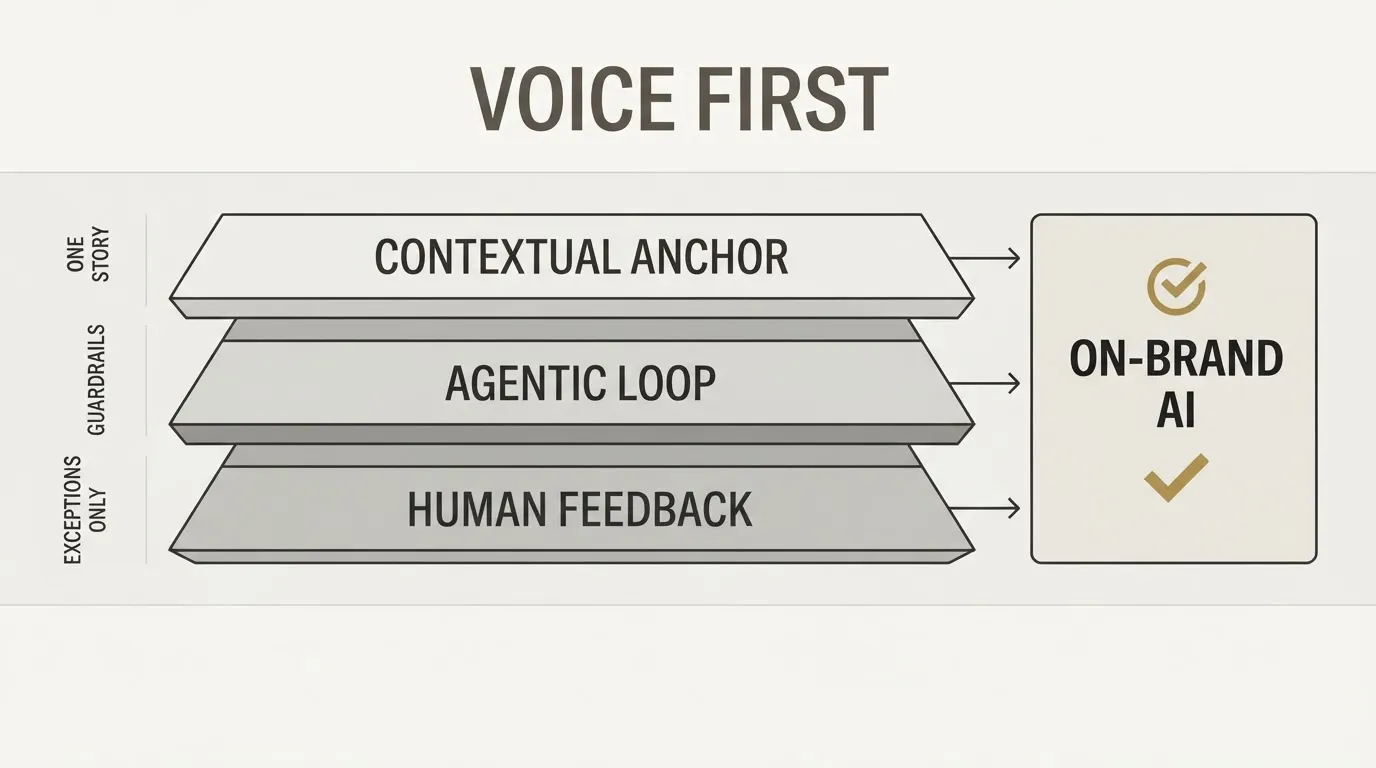
Subtitle: A voice-first framework for AI marketing automation that keeps brand voice consistency through files, rules, and approval-by-exception.
Introduction
You can maintain brand voice with AI marketing automation by giving AI a written operating system: one canonical story, platform-specific stance files, banned-language rules, and human review for exceptions instead of every asset.
Most teams think the fix is better prompt engineering. It usually is not.
Key takeaways:
- Write one canonical story before you automate volume
- Route AI through guardrails instead of loose prompts
- Review exceptions, not every asset
- Measure voice adherence like any other KPI
If your brand story lives in scattered docs, Slack threads, and unwritten instincts, automation will scale the chaos. That is why so much AI marketing content feels polished but forgettable.
Here, Brand Voice means the consistent personality, tone, and vocabulary a company uses across all communications. And Marketing Automation means using software to execute and optimize repetitive marketing tasks across channels without manual intervention every time.
The framework below shows how to maintain brand voice with AI by treating strategy as a file system, not a vibe. That means better inputs for ChatGPT, Claude, Cursor, or any workflow around your brand voice.
The generic trap is now a visibility problem
And once automation speeds up, the next problem appears fast: average content multiplies.
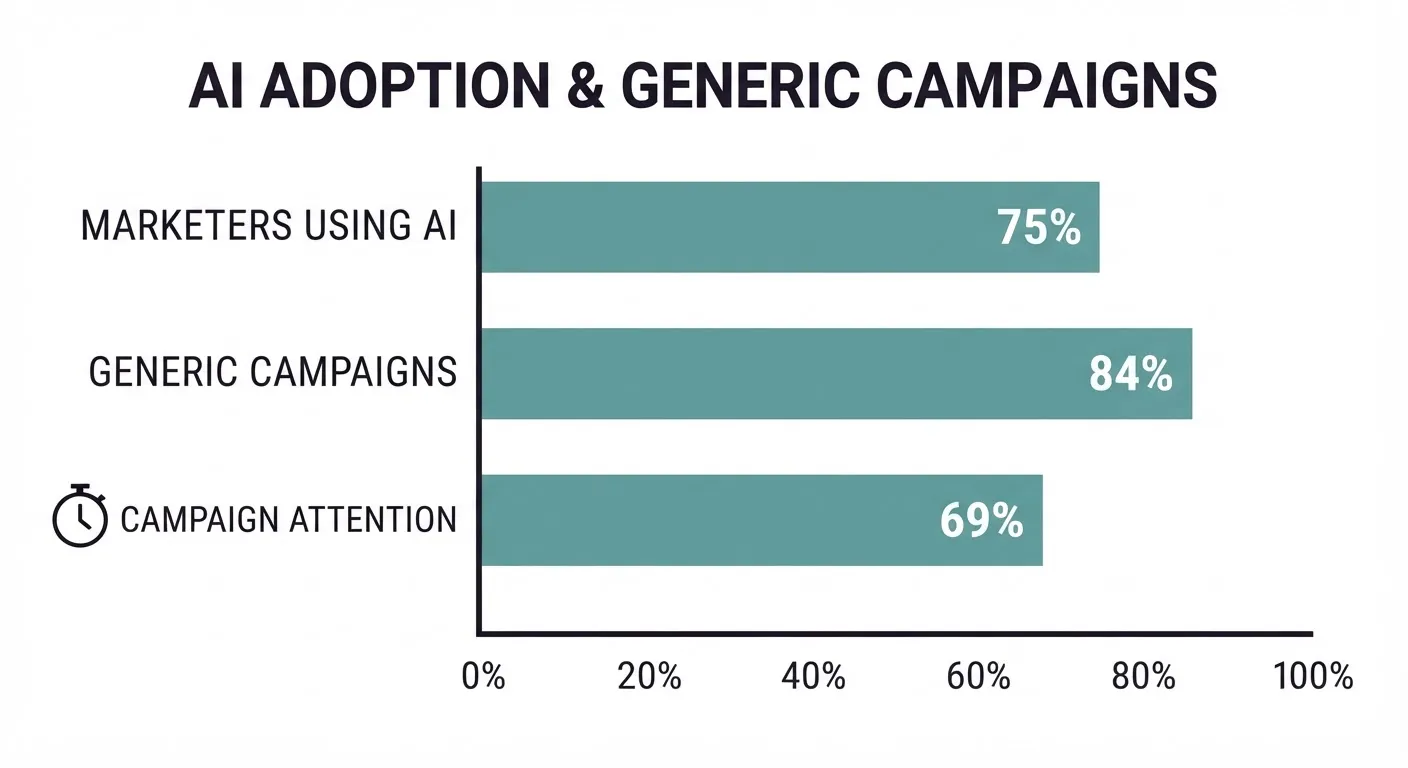
A recent Salesforce 2026 State of Marketing found that more than 8 in 10 marketers (84%) still run generic campaigns even though three-quarters (75%) have adopted AI. A recent Adobe consumer report adds the pressure: about 7 in 10 customers (69%) say brands have five seconds or less to capture attention.
- AI adoption is high but distinctiveness is still low
- Attention windows collapsed so bland copy loses before line two
- Speed alone is baseline not a durable advantage
- Content performance now depends on relevance and recognizable voice
In a five-second window, generic output is not just bland. It is expensive.
That changes the goal. The job is no longer producing more assets. The job is scaling a distinct point of view without sounding interchangeable.
Layer 1: Write the contextual anchor
So if prompting is not the root issue, what is? Missing source files.
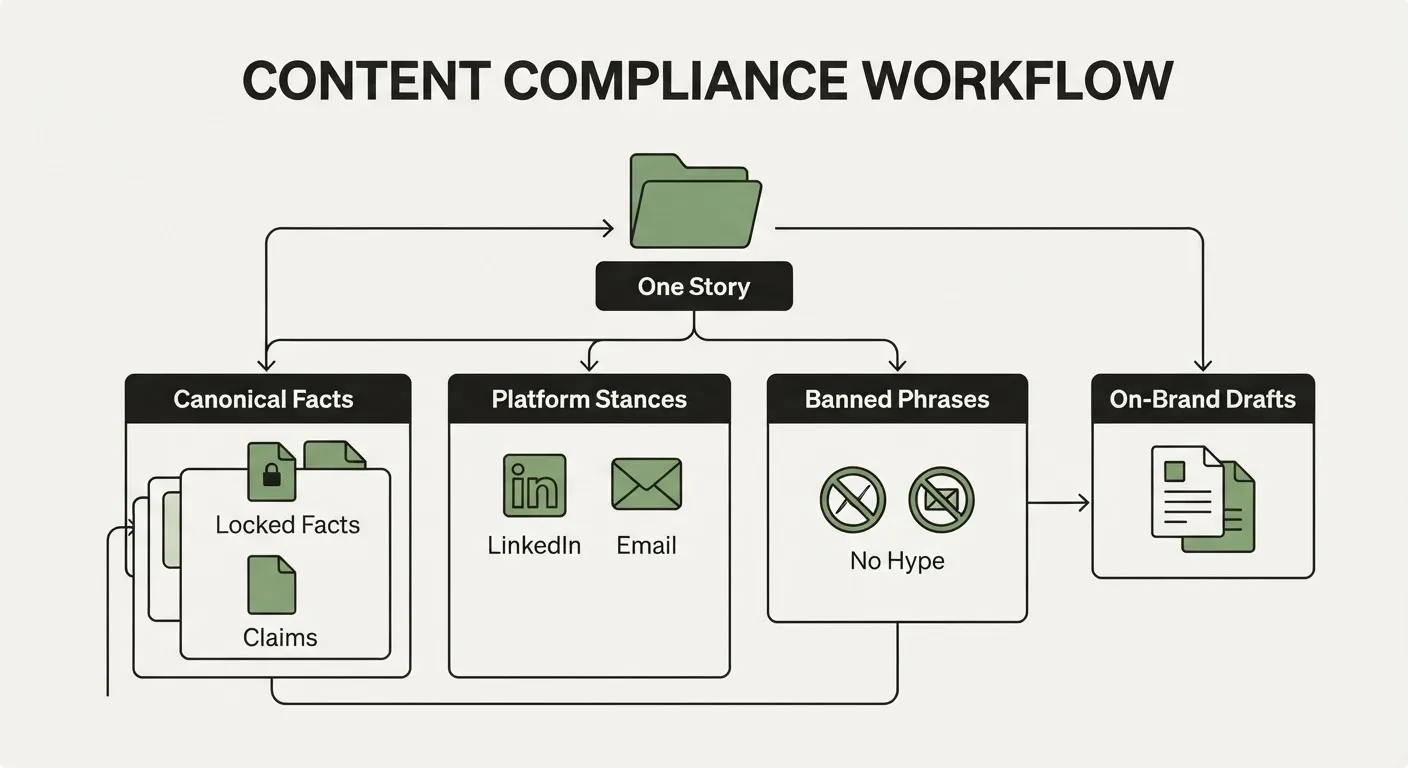
The fix starts with one written story that every model, prompt, and workflow pulls from. A recent Salesforce marketing study found teams satisfied with unified data were 42% more likely to regularly respond to customers, which is a reminder that clean context shapes output quality.
Based on what we saw when building around one written story, the only stable setup was to treat brand strategy as source files, not tribal knowledge.
Use a canonical-facts file with sections like these:
- Company truth: who we are, for whom, and why we exist
- Locked facts: claims we can support and facts we can safely repeat
- Audience truths: pains, desires, objections, and vocabulary they already use
- Approved positioning: our framing, comparisons, and strategic angle
- Refusals: what we refuse to say, imply, or exaggerate
Then create a stance-per-platform folder:
- Email: higher clarity, tighter proof, direct call to action
- LinkedIn: sharper opinion, more industry framing, less hype
- Ads: compressed message, explicit proof boundaries, no vague superlatives
- Comments: conversational, helpful, narrow claims, escalate uncertain facts
- Landing pages: strongest narrative continuity, clear value, clear limitations
Then add a banned-phrases list:
- Filler like “unlock,” “revolutionary,” and “game-changing”
- Unprovable claims like guaranteed growth or instant results
- Trust-breaking language that sounds inflated, evasive, or synthetic
- Compliance risks including unsupported comparisons and implied endorsements
Recent Adobe research shows why this matters. A content operations report found nearly half of organizations (48%) are optimizing content for AI-powered discovery, and three-quarters (75%) cite data integration and quality as major obstacles to agentic AI. Another Adobe B2B report found nearly three-quarters of firms (72%) cite skills gaps, which is exactly why explicit files beat ad hoc prompting.
Fine-tuned AI models can help, but they still need clean source material. Prompt engineering matters too, but prompts only work well when they retrieve from a governed brand system.
Layer 2: Build AI Marketing Automation Around the Rules
Once the files exist, the next question is where the human belongs.
If a human must review every asset, you do not really have automation. You have a slower content team with better software.
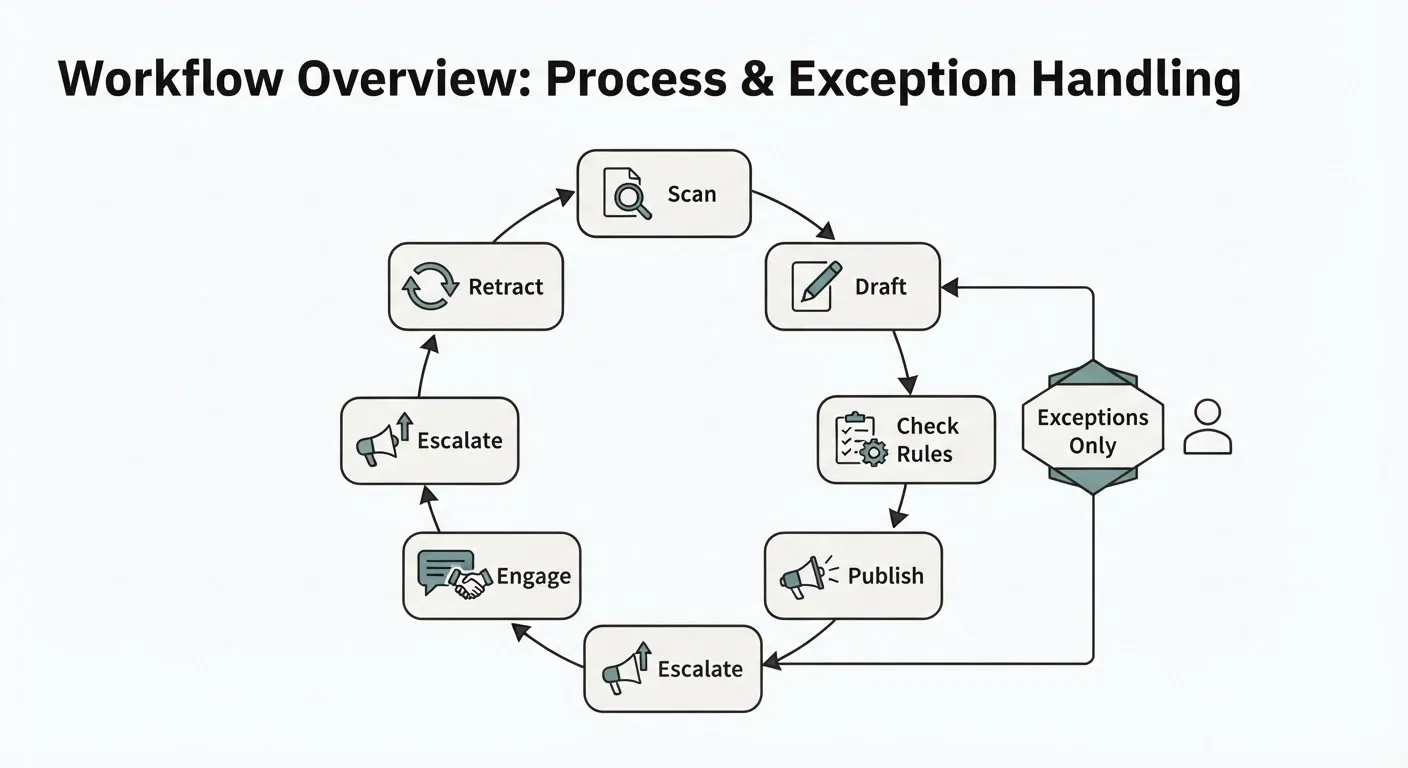
A workable loop looks like this:
- Scan for topics, signals, mentions, and reply opportunities
- Draft from the canonical story and platform stance files
- Check against facts, banned phrases, and risk rules
- Publish when confidence is high and policy checks pass
- Engage in comments and follow-ups within approved boundaries
- Escalate uncertain claims, sensitive replies, and edge cases
- Retract and learn when something slips through
That is approval-by-exception. The agent drafts inside written guardrails, and a human handles only the exceptions and the retractions.
Our rule is practical, not theoretical: reviewing every post would bottleneck the system, but reviewing the rules scales. In a 10-day stretch with 949 comments, the honest cost of approval-by-exception was 3 retractions, and we accept that trade because the workflow learns from each one.
Recent evidence supports the need for this model. An Adobe and Oxford Economics study found more than three-quarters of organizations (76%) say generative AI improved content speed and volume. A recent HubSpot State of Marketing report found 4 in 5 marketers (80%) use AI for content creation. And Forrester predicted B2B companies will lose more than $10 billion in enterprise value from ungoverned generative AI incidents.
Speed is now common. Governance is the edge.
Layer 3: Make brand voice a KPI
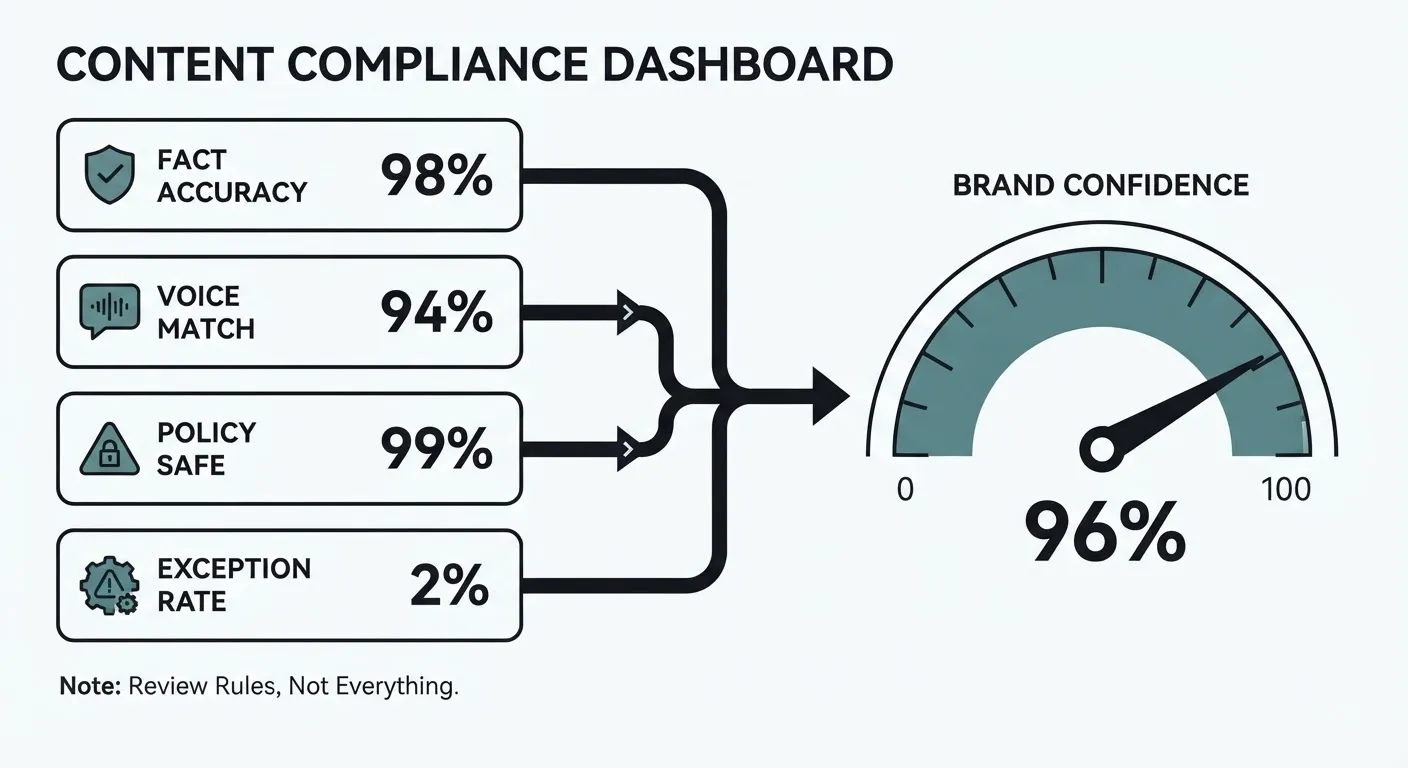
And once the loop is running, the final failure point is measurement.
Voice drifts when teams measure only output, speed, and volume. AI will optimize for whatever you score.
Track brand voice consistency with explicit pass-fail checks:
- Fact adherence: did the asset stay within locked facts?
- Stance adherence: did the channel sound like that channel?
- Banned-language compliance: did it avoid hype, filler, and risky claims?
- Exception rate: what share required human intervention?
- Retraction rate: where did published output reveal weak rules?
This is how voice becomes operational instead of aspirational. It also improves content performance because the system learns where trust breaks.
A recent Salesforce 2026 State of Marketing found more than 8 in 10 marketers (84%) still run generic campaigns despite widespread AI adoption. That gap is what your KPI should close.
If you never score voice, the model will quietly optimize around it.
When the framework breaks
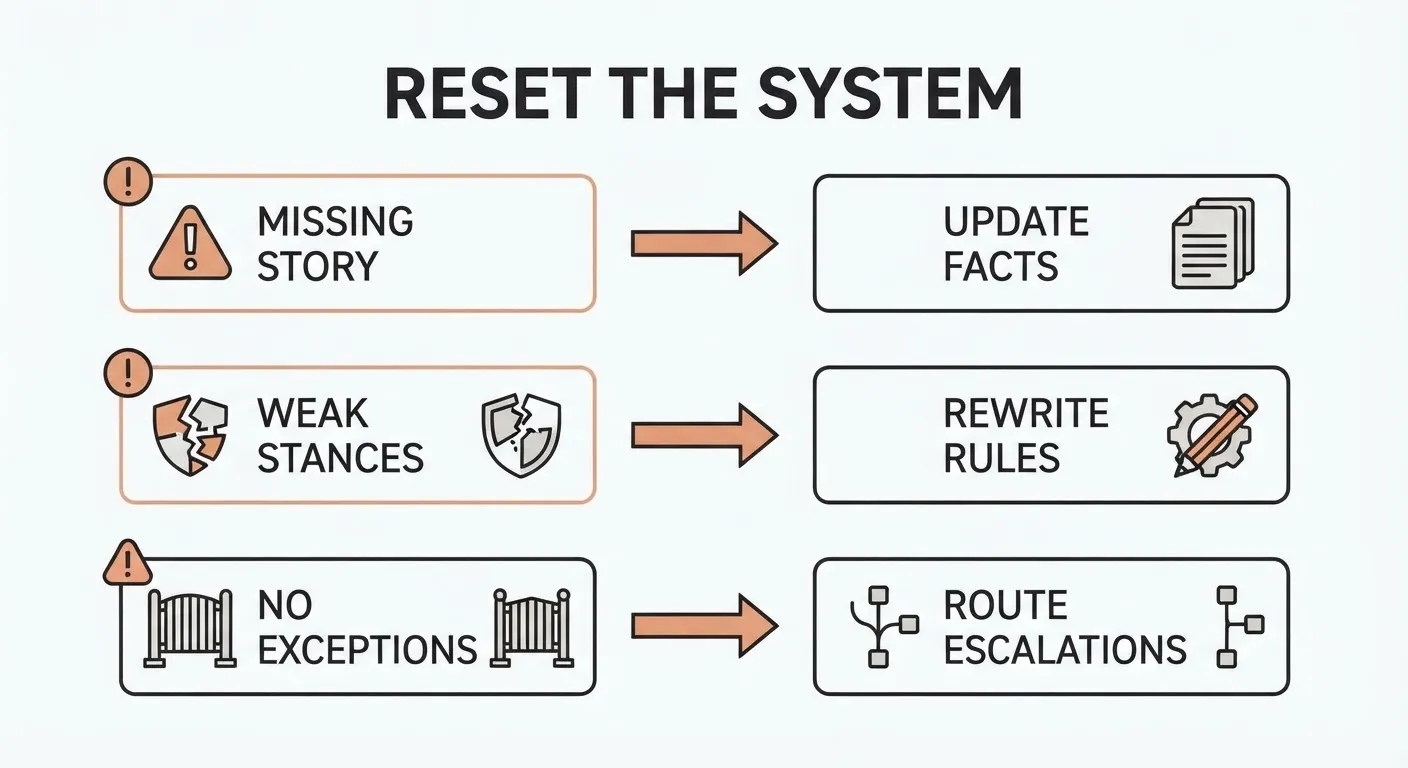
Even then, failures still happen. Most are governance failures, not model failures.
The most common breakage signs are easy to spot:
- The model invents emphasis because your real story is missing
- Every channel sounds the same because stance files are absent or stale
- Humans become emergency editors because no exception logic exists
- Replies overreach facts because the source file did not support the claim
The reset is usually one artifact: a written single story. Our rule is literal. There is exactly one story, it is written down, and every piece on every platform draws from it.
If a comment needs a fact not on that page, it gets rewritten so it no longer needs that fact. That file is both the data layer and the strategy layer: locked facts on one side, refusals on the other.
Reset in this order:
- Update the single story with missing facts and refusals
- Tighten banned phrases that created bland or risky output
- Refresh platform stances so channels regain contrast
- Retrain exception logic using retractions and escalations
Generic output usually comes from having neither strategy nor facts written down.
Your brand voice needs files, rules, and exceptions
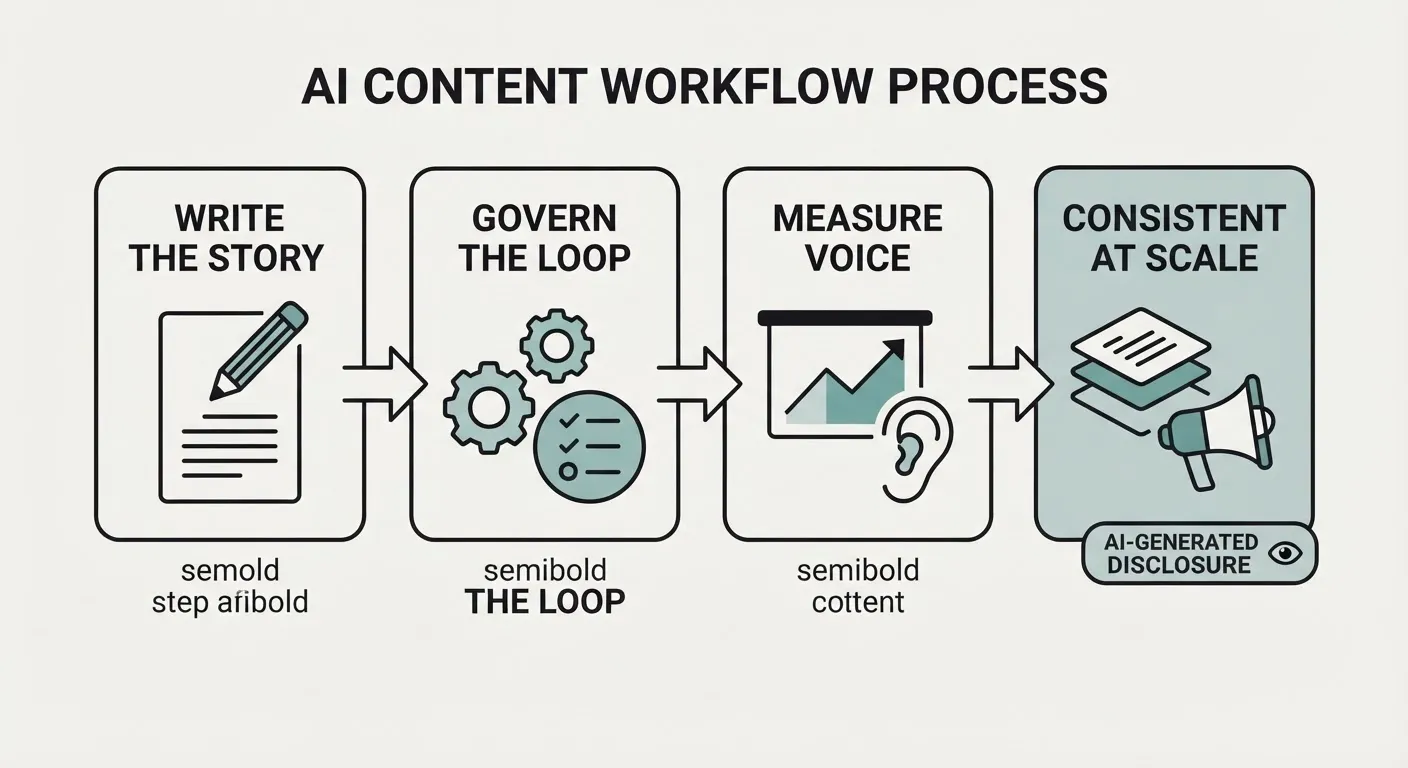
The opening problem was not that AI writes badly. It was that AI scales whatever operating system you give it.
Key takeaways:
- AI marketing automation needs source files, not just better prompts
- Brand guidelines must become machine-readable to protect voice at scale
- Approval-by-exception beats review-everything when volume rises
- Voice should be measured through adherence, exceptions, and retractions
So the answer to best practices for AI marketing automation is simple: start with one written story, route automation through explicit guardrails, and reserve humans for the moments that actually need judgment. That is how to maintain brand voice with AI without turning your team into full-time editors.
Keep the system concrete:
- One canonical story for facts, positioning, and refusals
- One stance folder per platform for channel-specific expression
- One banned-language file for filler, hype, and compliance risk
- One approval-by-exception loop for scale with accountability
For Scout7, that also means clear disclosure when content is AI-generated or Powered by Scout7 AI, avoiding unverified claims, and keeping endorsements attributable. Results may vary, but governance does compound.
If you want to apply this today, audit your current brand voice inputs, rewrite them as source files, and test the workflow across Claude, ChatGPT, and Cursor. The teams that win next will not be the ones using more AI. They will be the ones whose voice survives it.
Frequently asked questions
What is the minimum setup needed for AI marketing automation without losing brand voice?
Start with one canonical story that defines company truth, locked facts, audience truths, approved positioning, and refusals. Then add platform stance files, a banned-phrases list, and approval-by-exception so humans review edge cases instead of every asset.
Why are prompts alone not enough for AI marketing automation?
The article argues that prompts only work well when they retrieve from a governed brand system. If your story lives in scattered docs and unwritten instincts, automation scales that inconsistency.
What should a team measure to know the voice is holding?
Track fact adherence, stance adherence, banned-language compliance, exception rate, and retraction rate. Those checks turn brand voice into an operational KPI instead of something teams assume is working.
When should a human step in?
Humans should handle uncertain claims, sensitive replies, edge cases, and retractions. That is the logic behind approval-by-exception: review the rules and the exceptions, not every single asset.
References
- Salesforce, 75% of Marketers Have Adopted AI, Yet Still Use It to Send Generic Campaigns — https://www.salesforce.com/news/stories/state-of-marketing-2026/
- Adobe, Adobe 2026 AI and Digital Trends Consumer Report — https://business.adobe.com/resources/digital-trends-consumer-report.html
- Adobe, Adobe’s 2026 AI and Digital Trends Report: Key AI & CX Insights — https://business.adobe.com/blog/2026-adobe-ai-digital-trends-report-four-key-takeaways
- HubSpot, 2026 State of Marketing Report — https://www.hubspot.com/state-of-marketing
- Adobe, 2026 AI and Digital Trends in B2B Journey Orchestration — https://business.adobe.com/resources/reports/b2b-marketing-digital-trends.html
- Adobe, 2026 AI and Digital Trends in Content Creation and Management — https://business.adobe.com/resources/reports/content-management-digital-trends.html
- Forrester, Forrester’s 2026 B2B Marketing, Sales, And Product Predictions: B2B Companies Will Lose More Than $10 Billion Because Of Ungoverned Use Of Generative AI — https://www.forrester.com/press-newsroom/forrester-b2b-marketing-sales-product-2026-predictions/